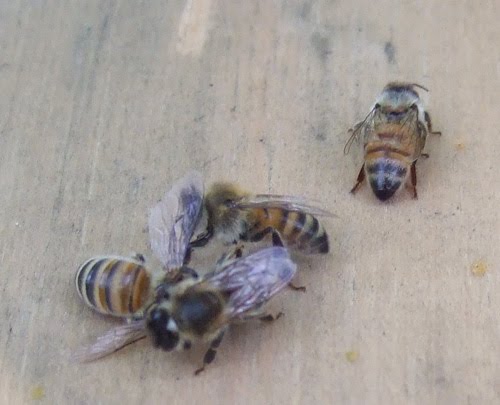
Saturday, December 23, 2017

Fun Fact: How Beeswax is Made

Fun Fact: Bees have pockets. Bees produce beeswax from their own bodies. On the underside of their abdomen are four pairs of wax glands. Under the wax glands are tiny pockets which hold the wax scales as they are being made.

When a wax scale is ready for use, the bee takes it out of the pocket by spiking it on the strong hairs of her back legs, and then passes it to the jaws.

There it is chewed, and other materials may be mixed with the wax. When it is soft, the worker puts it into place on the comb being built.

Source: Life of the Honey-bee - A Ladybird Natural History Book

Wednesday, December 20, 2017

Fun Fact: How bees cool the hive

Fun Fact: Bees air condition their hive the same way we do with water evaporation.

Bees will go out and bring back water,

Then they coat as a thin layer on the rims and caps of the cells.

Next, fanning bees will position themselves in a line up and will fan their wings.

With all the bees fanning together their combine efforts make a great air flow in the hive. 

When they fan like this it's called "stationary flying"

This video is of bees doing stationary flying at the hive entrance to pull hot air out and push cool air in.

Saturday, December 16, 2017

Fun Fact: How do bees see in the dark hive?

Fun Fact: When building combs in the darkness of the hive bees don't use their eyes to tell their position in the hive, whether they are standing vertically facing up or down, etc.
Bees have cushions of sensory (feeling) hairs at all their joints (knees and ankles etc) which move by gravity all together as the bee moves - sort of like how seaweed would sway in the waves back and forth.

This aids the bee to know in which direction they are standing by how these hairs move back and forth.

(taken from Jurgen Tautz book The Buzz about Bees - this book has incredible macro photography of the bees).

Thursday, December 14, 2017

Fun Fact: Bees have teeth

Fun Fact: Did you know bees have teeth?

They do on the inside edges of their wings.

Bees have four wings, two on each side.

The Fore Wing is the bigger wing and the Hind Wing is a smaller wing.

When she wants to fly she'll hook the teeth together on the inside edge of her wings.

Now she has two large wings that are hooked together.

She uses the large wings for flying.  She'll need these bigger wings, especially when she comes home carrying nectar or water or when her legs are loaded with pollen.

Once back at the hive she'll unhook the wings and tuck them back out of the way.

She in the photo, this bee has just come home and her wings are still hooked together but you can see how it's actually two wings on each side.

Monday, December 11, 2017

Fun Fact: What happens when bees fly?

Fun Fact:  When honey bees fly, their bodies create static electricity.

This is similar to us, when we walk across a carpet  or if we rub a balloon on our bodies - then it will stick to us.

Static electricity is helpful for honey bees.  It helps them collect pollen.

When the bee lands on a flower, the light weight powdery pollen quickly attaches itself to the bee's fur.

Then she'll use her legs to scrape the pollen off her fur.  

She'll add some nectar from her honey stomach to make it into a paste and that pasted lump is what she attaches to her back legs to fly home with.

See the photo of this bumble bee on a flower.  She is covered in yellow pollen.

She's opened up a Snap Dragon flower with her strong body and has crept inside to collect nectar and pollen.

Her fur is quite covered in the pollen.  She's already started to put pasted lumps of it on her back legs.

Friday, December 8, 2017

Fun Fact: Bees have Five Eyes

Fun Fact: Bees have five eyes.

They have two big compound eyes on the sides of their head and three tiny ocelli eyes on the top of their head.

Once they hatch the tiny eyes are hidden in their fur. 

The small eyes are used to detect movement.

Bees see with ultra violet vision and their favourite colour is blue.

Recently it was discovered that non blue flowers while put out a blue aura to attract the bees.

I wonder how the flowers learned that bees love blue?

Notice on this hatched bee that you can't see the tiny eyes because they are hidden in her fur.

Tuesday, December 5, 2017

Fun Fact: The largest organ in the hive

Fun Fact: Do you know what the largest organ in the hive is? It's the beeswax.

Recent studies have shown that the bees communicate through the wax by vibrations that they make with their bodies.

The wax also holds the warmth of bees' bodies and acts like an insulator to keep the incubating babies warm. One chore for workers is to be a Heater Bee. 

A bee may look like she's just standing on a capped cell doing nothing but if you looked at it with an infrared camera that shows heat, you'll see she's pressing her thorax (chest) to the cell cap.

Then she contracts her flight muscles to transfer heat from her body to the wax which will warm up the cell and the baby pupae that's inside the cell.

 They can stay in this squatted position for as long as 30 minutes. The worker will have her antennae resting on the cell which is believed so she can check the temperature through the sensitive antennae.

Saturday, December 2, 2017

Some Cells are left empty on purpose

Fun Fact: Bees will leave about 10 to 15% of brood comb in the nursery with no eggs. This is deliberate. 

One bee chore is as a Heater Bee.  These Heater Bees will make themselves hot by warming up their wing muscles.  Then they will dunk their body into an empty cell where the babies are incubating.

Next she will rapidly telescope her  body up and down for a period of time and then rest when she gets tired.

What she is doing is warming up the was of the cells close by which warms up the babies that are incubating so they don't get cold.  The bees maintain a constant temperature in the brood (nursery) area.

Before we learned this, when we would see an empty cell where all the babies are we thought the queen missed laying an egg in that spot.  But she didn't goof.  She does it on purpose.

This fun fact is from The Buzz about Bees by Jurgen Tautz.

Wednesday, November 29, 2017

Fun Facts: Bees can eat eggs

It is surprising to learn that if the queen lays an egg that is somehow damaged or faulty or if a worker lays an egg when she's not supposed to (since that's the queen's job) the workers will eat the egg.

I thought that was weird since bees eat pollen and honey but when I thought about it a bit more I realized that the egg could be good food for the bees as a source of protein.

If they threw the egg out as garbage it would be a waste of protein which keeps the bees healthy.

These fun facts are taken from an excellent book written by Jurgen Tautz.  It's called The Buzz About Bees - Biology of a Superorganism.

Friday, September 22, 2017

Second Post of Questions from a class in Germany

There are two posts of these fabulous questions asked by a grade seven class in Germany.

Q. Kieran S: How do bees make Babies?
A. The bees raise their babies in the wax honeycombs.  First, the queen lays an egg in a cell.  After three days the tiny egg hatches into a larvae.  The young bees will feed this larvae a pudding-like substance called Royal Jelly that they secrete from their mouth.  After a few days the larvae are then fed a mixture of pollen and honey.  Pollen has protein which helps the larvae to grow.  After about 8 days the cell is capped off by wax producing bees.  Then the larvae changes to a pupae and after about 24 days she will hatch as a bee.

Q. Mick: How fast are bees ?
A.  Bees can fly about 24 km per hour (15 mph)


Q. Hayden: how many bees are reproduced in a year?
A. In spring a hive may have anywhere from 20,000 to 40,000.  As summer comes along the population will increase to between 60,000 to 100,000 bees.  Most of the bees will be the female workers.  About 25% of the population will be male drones.  And of course one queen per hive.

Q. Hayden : can bees reproduce with wasps or hornets?
A. No they don't cross-breed which is probably a good thing because honey bees are much more gentle and non aggressive than wasps and hornets.

Q.Alina: How many bees live in a beehive?
A. In spring there are less bees but as summer gets going the queen stays busy laying about 1,500 to 2,000 eggs per day.  In summer there are usually between 60,000 to 100,000 bees in a hive.  They need a lot of workers so they can fly out to gather nectar and pollen from flowers.

Q.Lenora P: How long is a bee's life span?
A1. A worker in summer can live about two weeks to a month.  She will wear her body out with all her hard work and then she dies.  In winter when bees only fly out to poop, they can live for several months.

Q2. What do the male bees do ?
A2. The drone has a very important job and that is to pass on his genes to future bees by mating with a queen.  Every afternoon drones will fly out of the hive and go to a congregation area where they wait for a queen.  They race each other to mate with her first.  Unfortunately the drones dies after he has mated with a queen.

Q3. What are bees eyesight like ?
A3. Their vision is quite different than ours.  They can see ultra violet colours which are mainly blue.  That's why blue and purple flowers are a bee's favourite.  (See the link in the previous post with photos of what a flower looks like to a bee).

Q4. What animals eat bees ?
A4. Skunks, shrews (like a mouse), birds, hive beetles, bears, spiders, preying mantis, wasps and hornets are some animals and insects that like to eat bees.  Bears like to eat bee larvae because it's a good source of protein for them.

Q5. What do beekeepers do ?
A5. Beekeepers check inside the hive to make sure the bees don't have disease and also to check to make sure there aren't too many varroa mites.  Varroa mites are like fleas in a hive that suck on the bee's blood and they can make the bees sick.  In late summer and fall we open the hives and remove the frames of extra honey that the bees don't need.  We keep that honey to eat or to sell.

Q. Rishi : How do bees act when they see another species of bees?
A. Most of the time bees will ignore other types of insects.  In late summer though when there's less food available other insects will try to get inside a hive to steal some honey.  The bees are diligent to protect the hive and they can grab the intruder and force them out of the hive (kind of like a body guard).

Q. Hayden: why do bees have hives other than housing?
A. Bees in hive are what we call domestic bees because they are kept by people.  There are many wild bees that live in homes that they find.  Wild bees can live in the walls of a house as long as they can find a small hole to get in.  They love to live in hollow trees, an attic, an old barrel.  They are always looking for what they think will be a good home.

Q. Joshua: Do Bee’s have any rules ( like the rules they have for pooping) ?
A.

Q. Alex: what type of bee does the queen bee breed with?
A. The queen will leave the hive and go out to find a male called a drone to mate with.  She can mate with anywhere from six to twenty drones.  After that she never mates again and will stay in the hive and keep busy laying many eggs

Q. Joshua: Do Bee’s have any enemies? (animals)
A. Yes, skunks, raccoons, and bears love to eat bees and mice can be a problem with getting inside the hive.  A hive is a warm place with food so many insects and small animals want to go inside, if not for food, then to keep warm in cooler weather.

Q. Annabelle: Are there more male or more female bees?
A.  There are definitely more female bees called workers.  They do all the work of feeding the young, caring for the queen, processing the honey, foraging for pollen and nectar and guarding the hive.  About 25% of the population are male drones.  They will leave the hive daily to look for a queen to mate with.  Drones don't do any work or gather any food.  And, drones don't have a stinger.

Q. Annabelle: How long do bees live?
A. A bee can live a few weeks or up to about a month in summer.  Once she works outside the hive there are dangers that can injure her which will affect how long she'll live.  The workers will wear out their bodies with the hard work that they do.  In winter, they can live for many months since they only go outside then to poop.

Q. Annabelle: Which bees live longer, female or male?
A. I think the males live longer because they don't have to do all the work that the females do.  But once the drone mates with a queen he dies right away.

Q. Annabelle: How do bees decide who the Queen is?
A. The workers will choose an egg and when it hatches they will continually feed her Royal Jelly which makes her grow very quickly and develop sexual organs which makes her a queen.  The really fascinating question we have is, how do they decide what egg to pick to make a queen?  We don't know the answer.  But they must know something about it to make that choice.

Q. Annabelle: Is there also a king?
A. A hundred years ago the people thought that the large bee in the hive was the king and they called it the king bee.  Then they saw the large bee laying eggs and so they had to change that to call her a queen.  No, there is no king.

Q. Joshua: We say that bee’s make a”Buzz” Sound but what sound do they
really make?
A. They do make a buzz sound that you can hear when they're flying.  They call also make some little squeaks and the queens can make a pipping sound when they hatch.  The bees mostly communicate inside the hive with their chemical scents and also by vibrations that they make with their feet.

Q. Kieran S: how do bees drink
A.  The bees' proboscis is her tongue that she sucks up nectar with.  To drink she uses her tongue to suck up water instead.  She can also carry this water back to the hive to regurgitate to give others a drink

Wednesday, September 20, 2017

Questions from a Grade 7 Class in Germany


Q1.  Ashwini.B:  How long does it take to make a honeycomb?

A1.  Bees need to eat lots of honey to make honeycombs.  If they have honey available to eat, they can build a comb the size of 4" x 6" in a few days.

Q2. Do bees see everything as humans?
A2.  No, bees' vision is very different than ours.  Honey bees can see ultraviolet light.  Their favourite colour is blue.  Here's a link which shows how bees see flowers:
How bees and humans see flowers

Q1. Ami:  When did people find out you can eat honey?
A1.  We're not sure when humans first started eating honey but I expect it was a very long time ago.  If honey leaked out of a hive, for example, if a branch broke in a storm exposing a bee hive and honey I'm sure humans would check it out because we're naturally very curious.

Q2. What temperature can bees survive in?
A2.  Bees can survive in a very cold winter.  In parts of Canada it can be as much as -40 Celsius in the middle of winter.  Bees don't hibernate in winter.  They stay awake in their hive and they form what we call a cluster.  They stand close together and shiver their wing muscles on their back to generate heat to keep each other warm.  They don't heat the whole hive, they only heat themselves.  Just like penguins, bees on the outside of the cluster will be colder and will slowly move to the center to get warmed up and then move back to the edge again.  So each bee gets a chance to get warmer.

Q.  Hayden: where do bees have the most population?????
A.  I'm not sure which country has the most bees.  The number of bees can be affected by how much food is available (flowers) and also the type of weather in that country.  At certain times in the year there can be a huge amount of bees in one state.  For example, in the USA when the almond trees are in bloom, the beekeepers there put all their hives on trucks and drive them to California so they can pollinate the almonds.

Q. Alex:how many breeds of bees are there in the world?
A. In North America there are about 3,000 different types of bees.  The honey bee is the only bee that makes large amounts of honey.  They make so much that the beekeeper can take some honey and they'll still have a lot left to eat.  There are some stingless bees in some countries that make honey as well but not as much.

Q.  Leon: How much honey could a bee make in one day?
A.  In her whole life a bee might make as much as 0.8 grams of honey.  When the circumstances are perfect for weather and sunshine, the flowers will put out more nectar and on those days the bees can bring in more nectar than on other days.

Q.  Jose: What do bees use honey for?
A.  Honey is food that gives the bees energy so they can do activities.  They make a lot of honey all summer so that in winter when there are no flowers available and it's cold, they can stay in the hive and eat honey.

There are more questions which I'll answer in the next post.

Tuesday, May 30, 2017

A Bumblebee's Tongue

This is a queen bumblebee that was in my back yard.  I had some sugar water made up for honey bees and I offered her some.

Watch as her long tongue comes out to lick it up.  And if you watch carefully you'll see a little inner tongue that comes out of the big tongue and sweeps up the nectar.

Now you can see exactly what a bumblebee does when she puts her tongue into a flower.

Not even honey bees can reach as far into a flower as a bumblebee can.


Thursday, May 25, 2017

Bumblebees Play Soccer

In the last post we saw how researchers taught bumblebees how to pull string to reach a flower for food.  That was pretty cool.

This is pretty amazing.  They've taught bees how to play soccer.  First a fake bee was used to teach a bee how to move a ball into a circle to get a reward of sugar water.  After the bee figured out how to get the reward she could do it all on her own.

Then she taught other bees how to do it.  Watch this video to see for yourself:


Sunday, May 21, 2017

Monkey See, Monkey Do

Have you ever heard the saying monkey see, monkey do?  Or the saying copy cat?  These are examples taken from animals where one monkey watches another and then learns something and does it.  Cats learn by watching other cats.  This is where the saying copy cat comes from.  If you watch kittens you will see they copy what their mother does.

Below are videos where researchers at a university in England did an experiment with Bumblebees.

First they taught one bee in a step by step way how to get sugar water out of a fake flower.  The next thing they did was put the taught bee with an untaught bee.  Can you guess what happened?  The bee that knew how to pull get the sugar water taught the other bee to do it too.  This is called social learning. Watch this video on how the bees were taught:


We already knew animals were smart and could teach each other but now we know that insects can too.  I guess we can't ever call an insect dumb.

Wednesday, May 11, 2011

It's No Zoo - Queens in Cages

Yes, these queen bees are in cages but it's not at the zoo.


I bet you're wondering why someone would put queen bees in cages. There's a really good reason.


In early spring in Canada (April and May) the bees are slowly getting busy as the weather gets warm.


Many beekeepers have hives with so many bees that they want to divide the hive. Beekeepers call it splitting or making splits. When they take the bees from one hive and separate them into two there's a small problem. There's only one queen.


Bees can make a new queen (I'll tell you how they do that another time) but it takes over a month for a queen to grow up, hatch and mate.


During that time the hive can't do very much. So many beekeepers purchase queens from Australia. In Australia the weather has been warmer and their queens are already grown up.


Australian beekeepers put a queen in each cage to send to Canada.


The queen can't travel alone, she's too important. The Australian beekeeper puts some ladies in waiting into the cage as well.


The ladies will feed the queen, give her a drink of water, and will groom her fur. She can't arrive in Canada looking anything less than beautiful and nicely groomed.


The cage has a small hole in one end. The beekeeper puts them into the cage and then plugs the hole with a cork plug. There's a hole in the other end too and it's plugged up with candy.


The ladies in waiting will feed the candy to the queen while they wait to arrive at their new home.


The bees will fly... but on a plane! Hundreds of queen cages are carefully packed in cardboard boxes for their trip.

When they arrive they are tired and thirsty. At the airport the beekeeper puts droplets of warm water on a small square of cloth so the bees can sip it and quench their thirst.


At the bee yard the queen can't just be put into the new hive in Canada. The bees don't know her or her special scent. If she was just placed in the hive, they might think she's an intruder and sting her.


The cage is put into the new hive and the queen is safe in her cage. The bees will chew and chew on the candy to open the hole and let the queen out. By the time they finish eating the candy they will know the new queen and her special smell (call pheromones) and they will happily accept her in their hive as their queen.


Do you think Australian queens buzz with an accent? Listen to the video of the bees in their cages (below).


(Thanks to John at Oxford Honey & Supplies in Burgessville, Ontario for allowing me to photograph the queens).


Saturday, March 12, 2011

Wash Day

Do you ever have to help out at home? Would your parents ask you to help them clean?

Bees like to keep their house (hive) clean.

There are bees inside that are assigned the job to clean.

These photos and video show bees cleaning outside the hive.

They use their tongues like brooms and they sweep back and forth.


If you watch the video you'll see it's almost like a dance as they move their heads back and forth in a steady rhythm.

There's a saying: Many hands make light work. It's true that when more people help out the job gets done much faster.

I guess the bees' saying would be that many tongues make light work.

They understand the power of working together to get big jobs done.

That's probably why your parents ask if you can help out to. It makes everyone's job easier.

It's more fun to work when others are with you too.

See the bees sweeping with their tongues in the video below.


Friday, March 4, 2011

Karate Bee

Have you seen the Karate Kid movie? Karate has some really cool moves and so does this bee.

She's a guard bee and she's striking her karate pose.

What do you think she's saying? "Don't mess with me I'm protecting my hive." That's what she's saying.

Compare the first photo to the second one of a standing bee pictured below.

See the difference? The second bee is relaxed and just hanging around. She's not a guard bee.

Guard bees have the job of protecting the the hive. They're like security guards.

They have to check the ID of every bee that wants to come in the hive. They check ID by scent.

Bees from the same hive all have the same smell. If you smell right then you can come in.

When field bees fly back to the hive they'll go close to the guard bee. She'll turn her head, her antennae can sniff them.

But if there's a problem and the hive has strangers coming by, maybe bees from other hives, a hornet or a wasp, the guards will stand back on their legs in an attack mode.

If there's an emergency or danger from a bear, skunk, raccoon or some other creature the guard bees will release a chemical scent that tells the hive to attack. That's when more bees will come out and sting the intruder.

The bees know that they make precious golden honey that many creatures want to eat.

They guard their gold very well.

Monday, February 28, 2011

Undertaker Bees


Bees and people aren't too much different.

When a person dies there are people who have the special job of taking care of the dead body.

When a bee dies there are workers who have the special job of taking care of the dead body.

See? Bees are like people... or maybe people are like bees.

Nature is marvelously designed so that each little bit and piece is not wasted. When we see a dead animal on the side of the road it can be sad. But nature will take care of these corpses by helping to remove them. Little beetles and flies that specialize with dead animals will come and do their job.

If a bee dies outside in the field, she'll fall to the ground. Her body will most likely become a meal for a foraging mouse, a bird, wasps or ants.

Where my bee hives are I've watched as a bird flew down to pick up dead bees to eat.

Inside the hive, if the bodies of dead bees can't be left to pile up otherwise there would be a crowded mess. And it wouldn't be clean.

Have you ever picked up a dead fly and found it to be very lightweight? That's because it's body has dried out over a few days.

Undertaker bees will sometimes wait a few days so a dead bee body will dry out. Then it won't be so heavy to carry.

They grab the body and half fly and half drag it out of the hive. Sometimes the bee will be heavy and big like the drone in these photos and video. Then another undertaker bee will come and help.
They'll pull and yank the dead bee across the platform outside the hive. At the edge they'll actually fly off, carrying the body and then they'll drop it.

It's all in a day's work for the undertaker bees.

Thursday, February 24, 2011

Lazarus, Come Forth!

The story of Lazarus is about a man who died and then came back to life. This is a story like that.

Last time we looked at how bees form a cluster inside their hive so they can keep warm all through the long cold Canadian winter.

We also looked at how bees are awake in the hive, eating their honey. Then on winter days that aren't too cold the bees will fly out to poop.

Before the bees fly out they warm up their flight muscles.

The bees in these pictures flew out but they must not have warmed themselves up enough before they left the hive. They fell to the snow where their bodies grew cold and they froze.

Have you ever gone outside on a winter day and you didn't dress warm enough? Sometimes I've thought it wasn't that cold and then after I'm outside I wish I had my hat or scarf so I could keep warm.

Once on the snow these bees would try to get warm enough to fly but usually they get too cold and they can't. It's sad that they die....
except for the day when I was there.
I scooped up a handful of bees and I held them in my cupped hands for about ten or fiften minutes.
Slowly I started to feel a little movement inside my hands, a little foot would wiggle here, a little head would turn there.
I'd keep my hands cupped so that the heat from my skin would warm the bees.
Like the story of Lazarus the bees came back to life. They woke up from their cold dead stupor. I warmed them up enough that they could fly.
Sometimes I wish I could be at my bee yard every day so I could warm the bees. But that wouldn't really be right. Nature has a plan and the bees live short but productive lives.

The queen, safe and warmed inside the hive will soon lay more eggs and there will be more bees.
This is a video of me warming up the frozen bees.

Sunday, February 20, 2011

Snow Day.... for Bees

Winter in the bee yard can look very lonely and quiet.

The hives sit unmoving and there's very little activity outside.

We have cold winters in Ontario, Canada, so beekeepers put covers called 'wraps' around their hives.

The wraps are like putting a blanket on the hive. It helps to keep the bees warmer by stopping the cold wind blowing into the hive.

The beekeeper will also put a piece of wood across the large entrance of the hive, leaving only a small hole for the bees to come and go.

Are you wondering about bees coming and going in winter? They do, just not very much. You see bees don't actually hibernate. Hibernating would mean sleeping a lot and not eating. The bees stay awake all winter and they snuggle together on their honeycombs in a tight cluster.

They shiver their wing muscles, which is like exercising and it makes their bodies warm. By snuggling they share their body heat. Just like how penguins form a cluster and cycle from the outside edge where it's colder to the inside where it's warmer, bees will take turns being warmer in the middle.

Can you guess what food they'll eat? Honey of course. All their hard work all summer long is for this moment, the cold days of winter. They can eat their honey and use it's energy to keep themselves warm.

But there's something else that happens when you eat..... you have to go to the bathroom! On days when it's not so cold the bees will actually fly out of the hive to poop. If they don't get too cold they'll make it back into the hive.

[See this photo - you can learn more about how this became Yellow Snow here].

Unfortunately, some bees will get too cold when they fly out and they'll fall to the snow. Then they can't warm up their muscles enough to fly. That's sad because they'll die.... unless I'm there to warm them up.

I'll tell you about that next time.